| NORFOLK | NORWICH | GT. YARMOUTH | KINGS LYNN | NAME SEARCH | PUBLICATIONS | LINKS | MYSTERY | HOME |
| NORFOLK PUBLIC HOUSES |
|
|||||||||
|
||||||||||
|
|||||||||||||
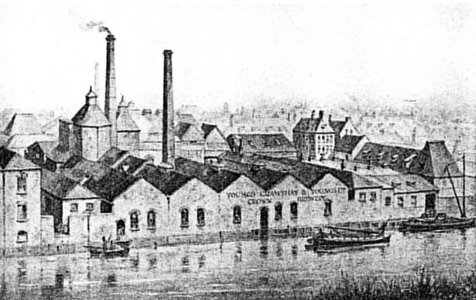 John Youngs is recorded as brewer in 1807. In 1814 a notice was published in the London Gazette announcing the partnership of Jonathan Davey and John Youngs, the brewers Davey & Youngs, was to be dissolved. The company continued trading as Youngs & Company. By the 1830's the company was run by John Youngs and his partner Mr Burt - Youngs & Burt The aged persons of Doughty's Hospital were most grateful for the quart of Mr. Crawshay's good stout they each received on Christmas Day, 1839. The Diss Brewery and twenty five Norfolk public houses were purchased March 1876 for £30,000. Charles Crawshay was associated with a brewery at St Stephens Gates. ( Richard Crawshay sold this in 1851.) Charles Crawshay joined John Youngs at the Crown Brewery and the new enterprise was initially known as Crawshay & Youngs, but later Youngs & Crawshay. Mr Robert Carss Youngs joined and Youngs, Crawshay & Youngs was formed. ~ 26th May 1869. Messrs. Youngs, Crawshay and Youngs informed their Friends and the Public, that following the late fire, they had made such arrangements to enable them to continue in Business without interruption. Mr. Hitchman and the Norwich Fire Brigade were thanked for their exertions which, with the hearty assistance of others present, had put a speedy end to the conflagration. ~ The articles of Partnership dated 17th March 1888 included under Article 2 that the Crown Brewery was the separate property of John Youngs the Elder. Registered as a limited company November 1897 with directors John Youngs, Charles Crawshay, Charles T Collier and Walter C Crawshay. ~ Charles Crawshay J.P. and of the Crown Brewery, died 25th October 1899. His estate was valued at £196,869, 11s 3d gross of which £190,170 6s 10d was the net value of his personal fortune. Beneficiaries were his wife Mrs. Eliza Maria Crawshay, his sons, Charles Edward and Walter Cubitt Crawshay, his daughters and others. Each child was to receive £100. Mrs Crawshay was bequeathed £500 and use of his effects to a value of £1,000, 25 dozen bottles of wine and a life annuity of £500. Charles Edward Crawshay was nominated as director of Youngs, Crawshay & Youngs. To his daughters Gertrude Mary Matilda £5,000 and £20,000 in trust plus ten dozen bottles of wine. For daughter Lucy Georgiana Bush, £5,000 and £20,000 in trust, also ten dozen bottles of wine. For daughter Emily Jane, £15,000. His servants of ten years' service, each to receive one year's wages. Victoria Ramsden £50 and a life annuity of £30. His solicitor, Thomas Keith, £105. The sons to share equally the remainder of the wine and the residue of his property. ~ Mr Dennis Tyrell, head brewer, received a special Diploma of Merit in
1923. |
|
||||||||||||
The directors in 1937 were Captain W S C Crawshay (Chairman), Raymond G
Collier and William Buston
The brewery site covered some 3 acres and the company produced
12,000 quarters of malt per annum in their 5 malthouses.
In 1900 the company decided to run its own Architects and Surveyors
Department.
YC&Y became pioneers in modernising houses.
`At that time brick floors were common, sprinkled with sea sand.
There were spittoons and counter fronts were provided with a narrow trench
at floor level
to confine a layer of sawdust for those indulging in the objectionable
habit of spitting.'
YC&Y removed spittoons and introduced Lino, carpets and rugs to such
houses and advised their tenants
that a clean floor would be respected by their customers.
The company built several new properties, omitting
`the superfluous shapings and mouldings, plate glass windows and
over-ornamented stone work'
to be replaced with
`much more restrained architecture, restoring to these houses a dignity to
which the true licensed house is entitled.'
Both the R.I.B.A and the Norwich Society were reported to express
approval.
Sadly many of the distinctive houses have been demolished in recent years
or heavily remodelled.
In c1935/6 there was an Exhibition of Inn Signs in London.
Initially 12 signs were requested by the hanging committee to be
exhibited.
Such was the quality and popularity that a request came for `any further
ones available'.
All were hung in prominent positions, `that of the Royal Arms being
positioned in the premier and central place'.
~
50 tied houses when taken over by Bullards 1956.
Brewery closed 1958
Mr W B J Crawshay was appointed a director of Watney Combe Reid &
Co Ltd 21st April 1965.
He had previously been a director of Bullards.